
Poincaré maps can be used as a "brute-force" method to find periodic orbits in a circular restriced 3-body system. This GIF shows Poincaré maps for the Earth-Moon system across many energy levels. These maps are generated by propagating lots of 2D trajectories in the Earth-Moon system with random initial conditions (constrained to a specified energy level). Whenever these trajectories cross the x-axis in the direction from +y to -y, the x-position and x-velocity are plotted as a point on the Poincaré map. The "loops" in these maps represent quasi-periodic orbits in the 3-body system, with a periodic orbit in the center of each loop. The "dusted" regions represent chaotic motion. Animating these maps shows how the periodic orbits move, appear, and disappear as the energy level changes.
Lyapunov Orbit Families
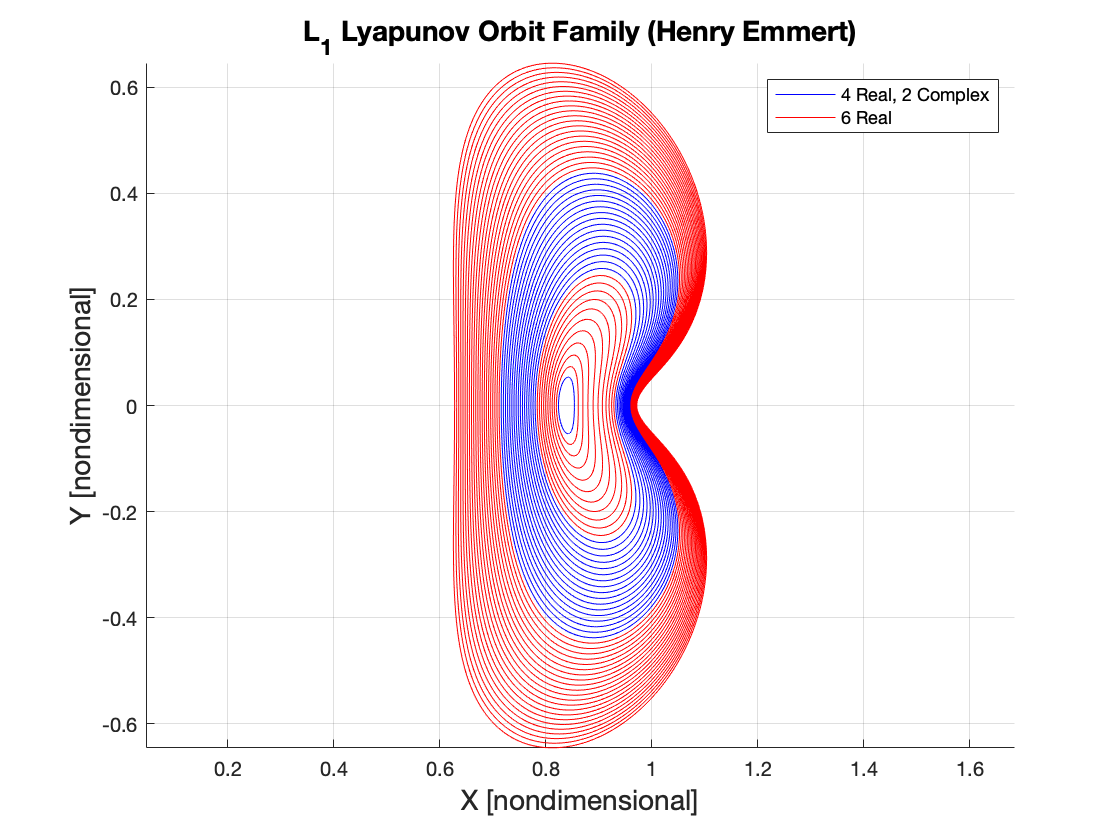
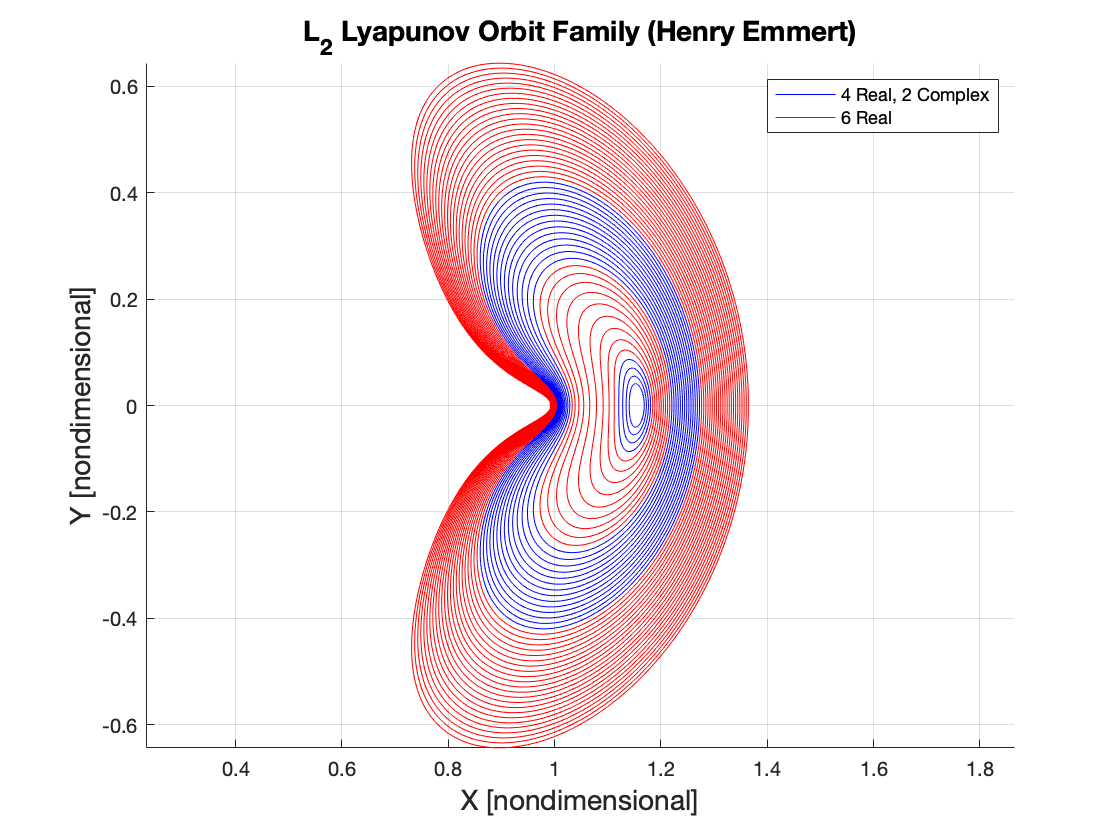
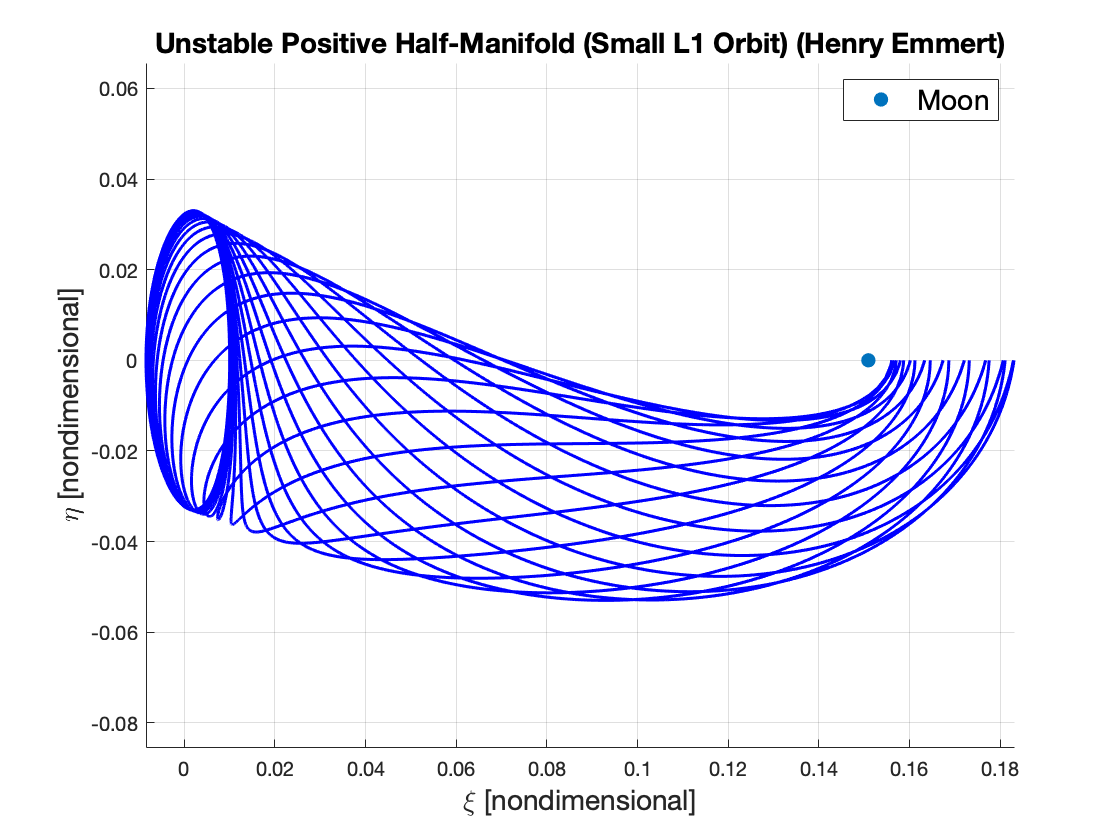
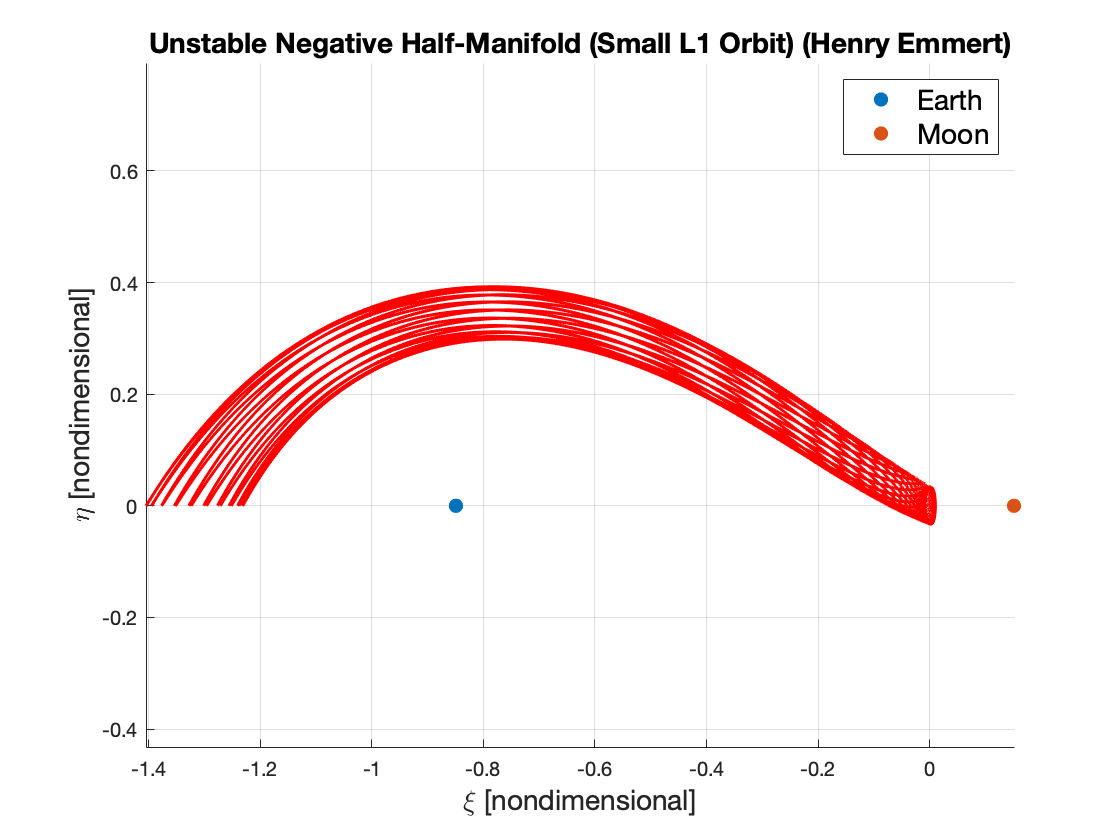
Lyapunov orbits are in the same plane as the Moon's orbit and are centered around the L1, L2, and L3 Lagrange points. These orbits can be solved analytically by linearizing the dynamics at a Lagrange point, but this is only accurate for the near-elliptical orbits very close to the Lagrange point. The nonlinear orbits above are found by starting with a linear orbit and using a continuation process with an iterative targeting solver to find larger orbits.
A monodromy matrix maps deviations at the beginning of an orbit to the final deviations after exactly one orbit. The eigenvalues and eigenvectors of this matrix provide more information about these orbits and their families. Deviations along the unstable eigenvectors represent trajectories leaving the orbit, and deviations along the stable eigenvectors represent trajectories entering the orbit. These trajectories are called manifolds, and they form a "tube" when many of them are plotted together. These manifolds can be used to enter or exit a Lyapunov orbit using only natural dyanamics.
Deviations along the marginally stable eigenvectors represent different orbits in the same family. In the plots of the Lyapunov families above, the transitions from blue to red orbits represent bifurcations where there are multiple marginally stable eigenvectors. These bifurcating orbits represent an intersection between the Lyapunov family of orbits and another family (one of which is the Halo family).
Heteroclinic Transfer Between Lyapunov Orbits
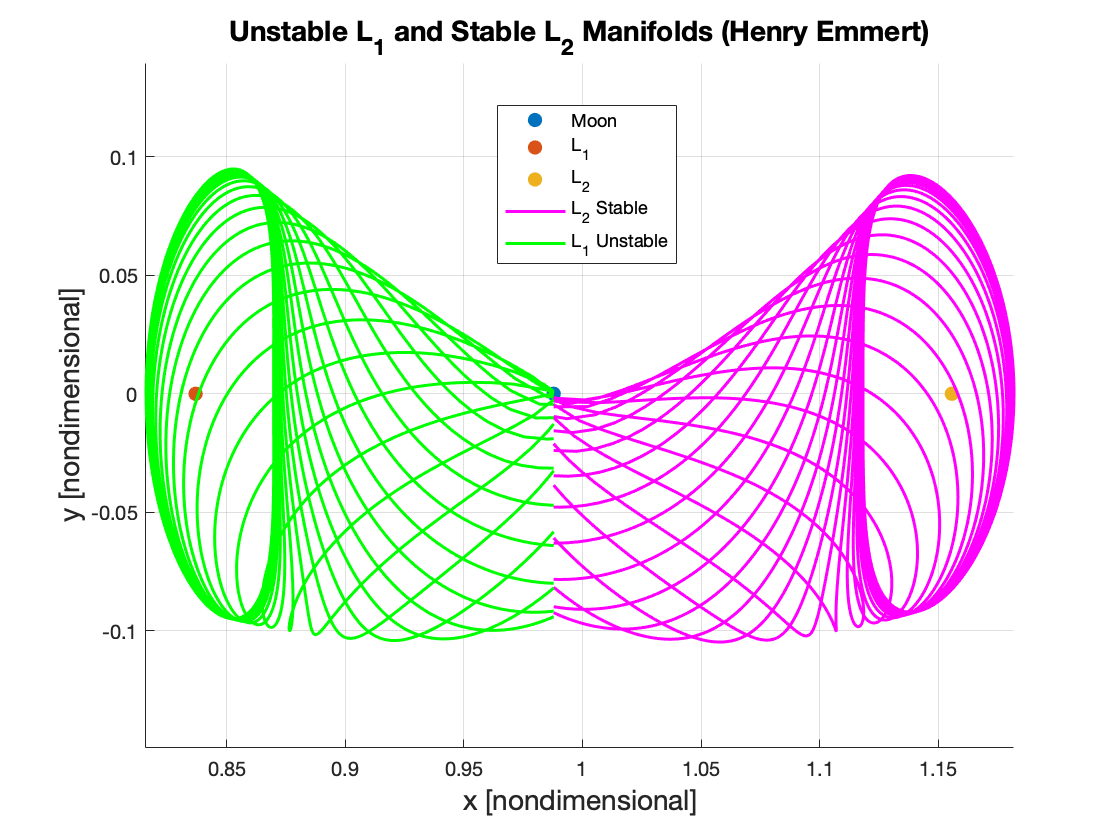
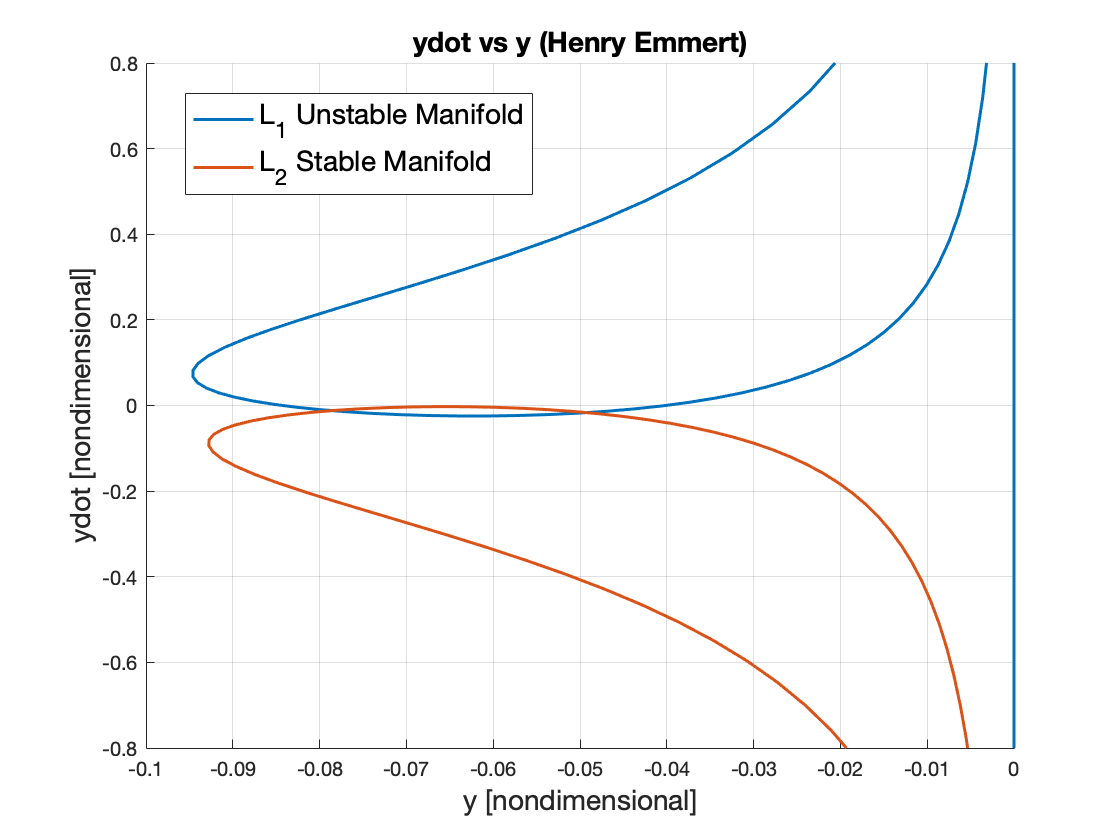
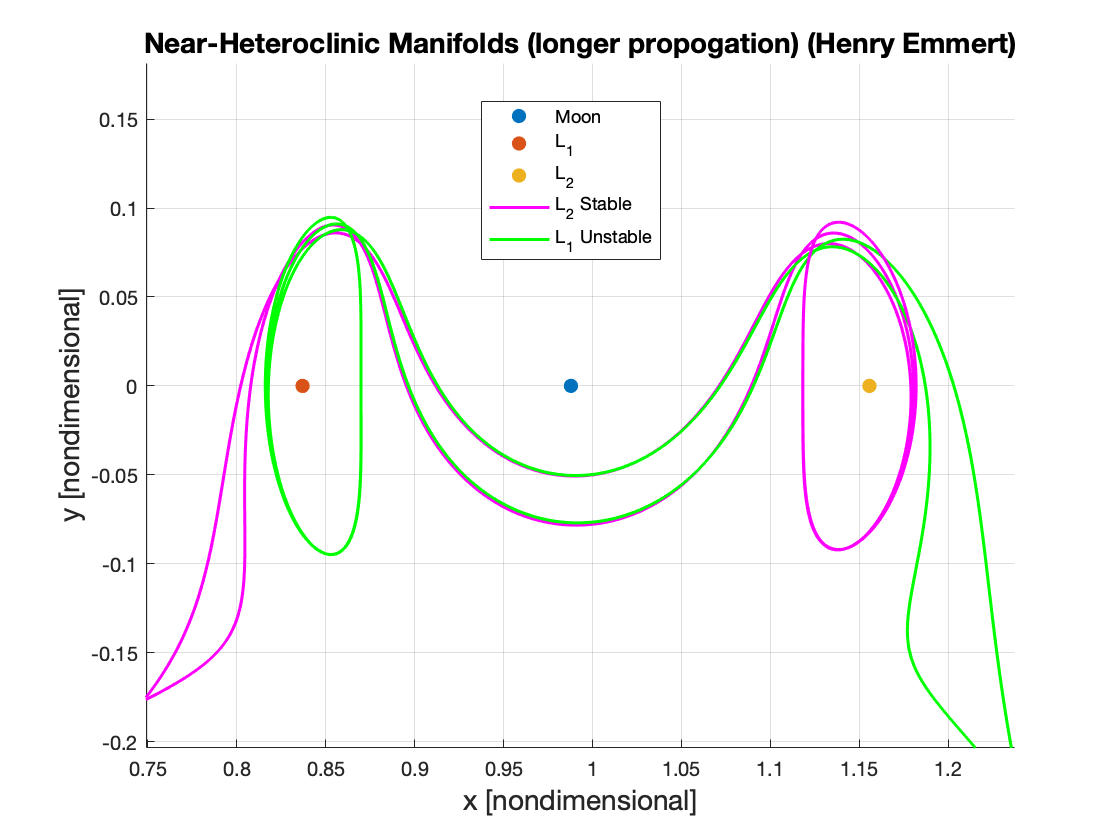
The stable and unstable manifolds of Lyapunov orbits can be used to transfer from an L1 orbit (near side of the Moon) to an L2 orbit (far side of the Moon). The idea is to find an unstable manifold from L1 that lines up with a stable manifold to L2. This can be found by plotting the y position and velocity for each set of manifolds when they intersect the plane defined by the x position of the Moon. The intersections of the stable and unstable manifolds in this plot represent trajectories that are on both the L1 unstable manifold and the L2 stable manifold. Following such a trajectory leads to a natural transfer from one Lyapunov orbit to the other.
Halo Orbit Families
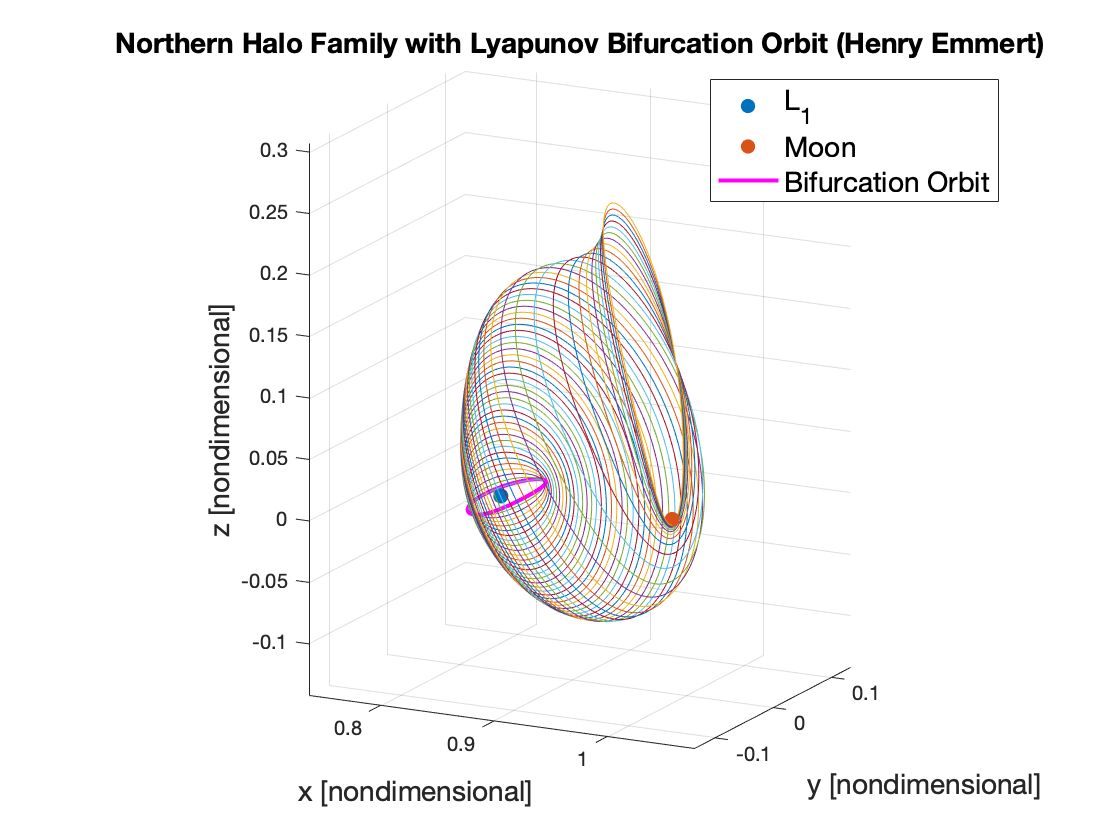
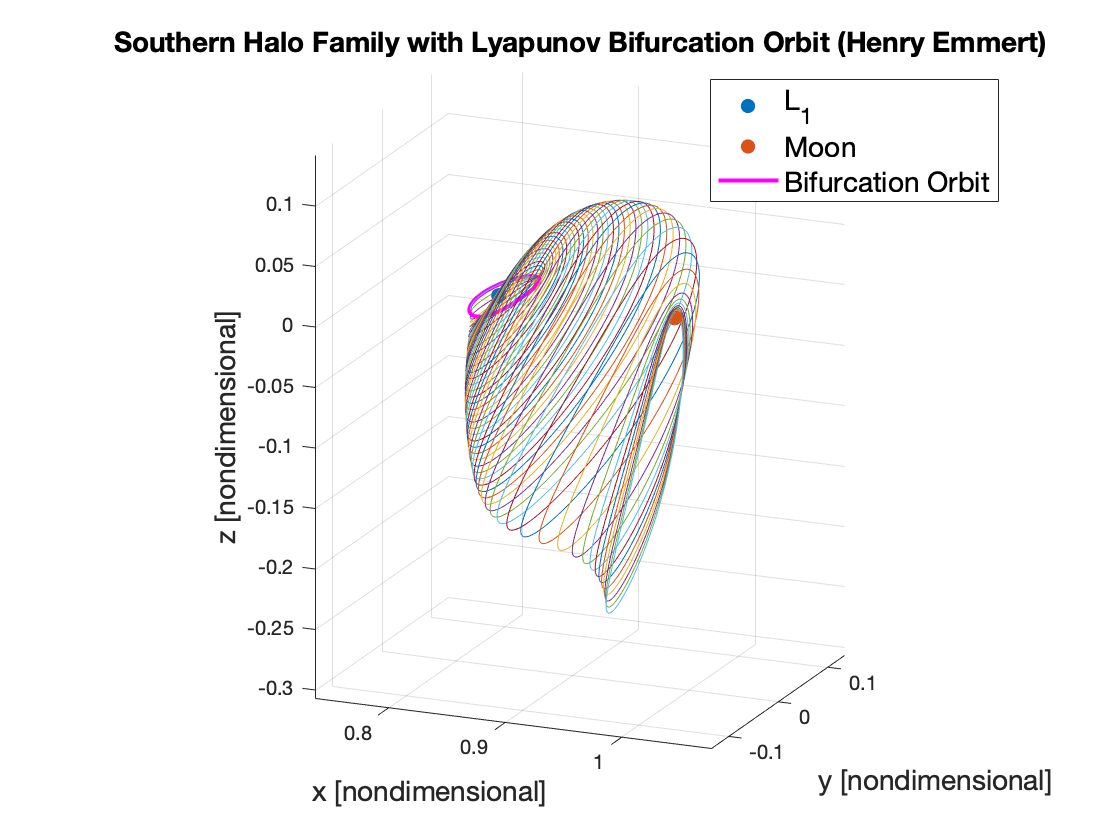
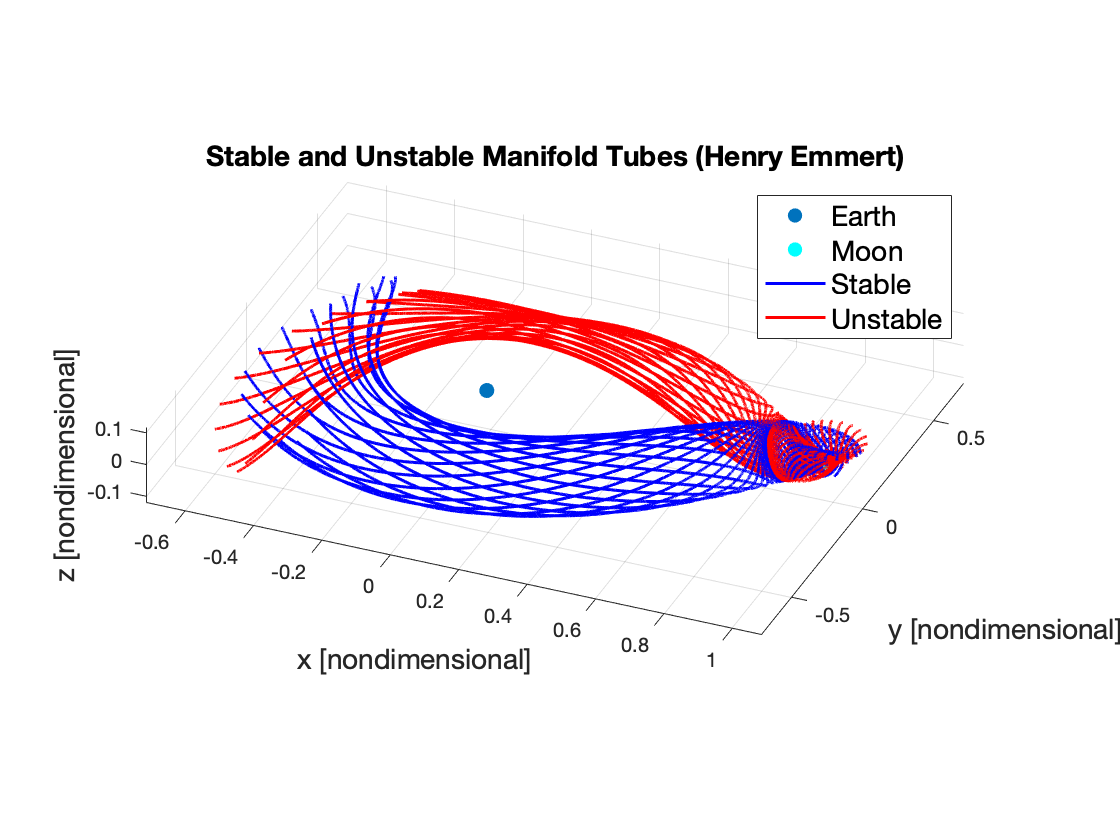
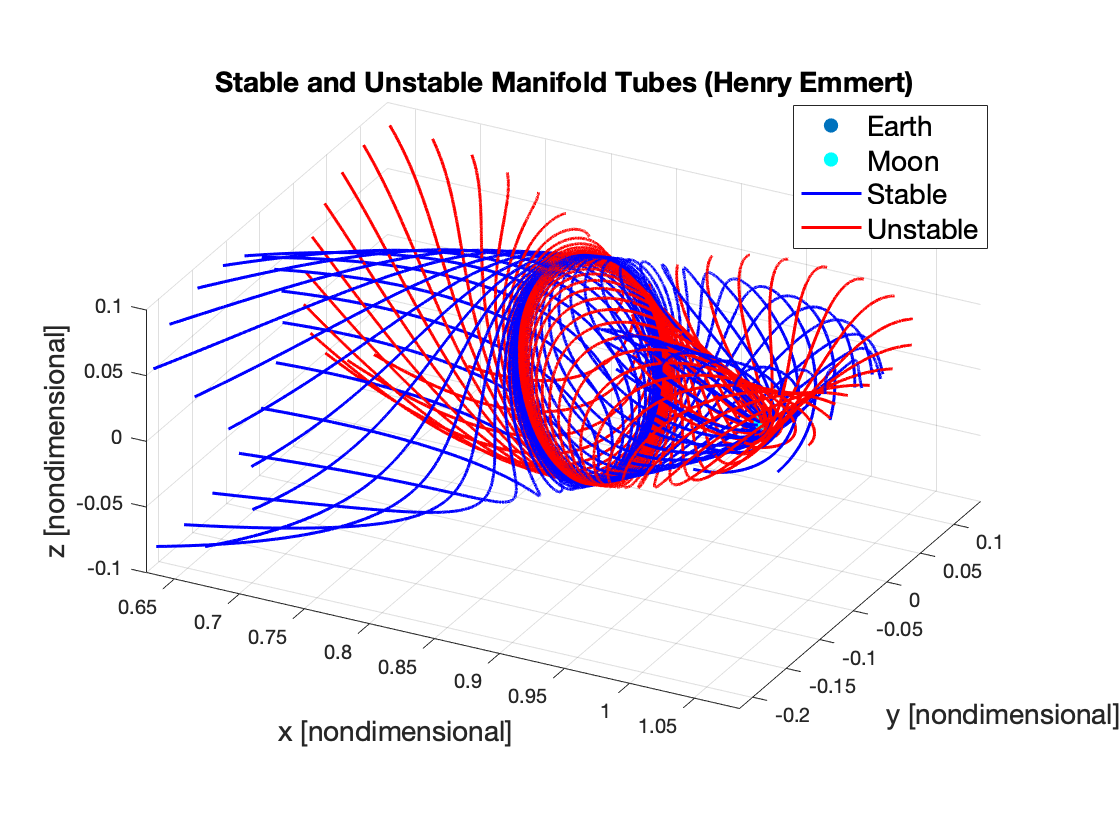
Northern and southern Halo orbit families bifurcate from the Lyapunov families. Using the bifurcating Lyapunov orbit as a starting point, a continuation process can be used to solve for the families of Halo orbits.